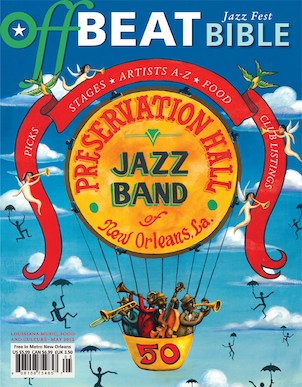
Within the span of two days, music fans attending this year’s Jazz
Fest will have the extremely rare opportunity to time-travel more than a
half a century, in some cases close to a whole century. It’s easy. Hear
the
Preservation Hall Jazz Band in the festival’s traditional jazz venue, Economy Hall, on
Saturday, May 5, and then go hear them on
Sunday, May 6,
when they will take to the Gentilly Stage as the Preservation Hall Jazz
Band and Friends. That show is essentially a continuation of their 50th
anniversary concert at Carnegie Hall on December 7, 2011, which itself
was essentially a continuation of their 2010 release,
Preservation,
on which old-timers including Merle Haggard and Tom Waits trade guest
appearances with rockers such as Jim James and Jason Isbell, folkies
Pete Seeger and Ani DiFranco, Paolo Nutini from Scotland, the Blind Boys
of Alabama, the Del McCoury Band, Dr. John, Angelique Kidjo and so on.
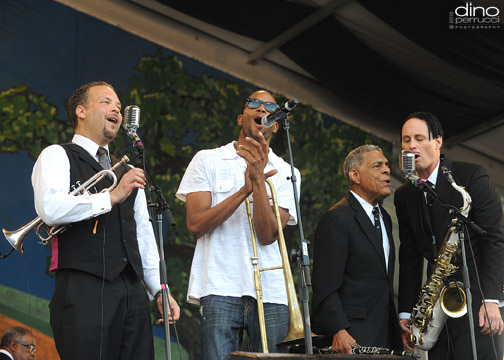
Who might appear on stage Sunday? Several artists have been
announced: Allen Toussaint, Trombone Shorty, the Rebirth Brass Band,
Bonnie Raitt, Jim James, Steve Earle, Ani DiFranco, Wendell Eugene,
Lionel Ferbos, and Jazz Fest founding producer George Wein, but there
may be more. Guessing possible “surprise” guest artists is a favorite
Jazz Fest pursuit, but think who you’re guessing about. The Preservation
Hall Jazz Band. When’s the last time you dialed them up on your iPod?
How’d the Preservation Hall Jazz Band suddenly get hip?
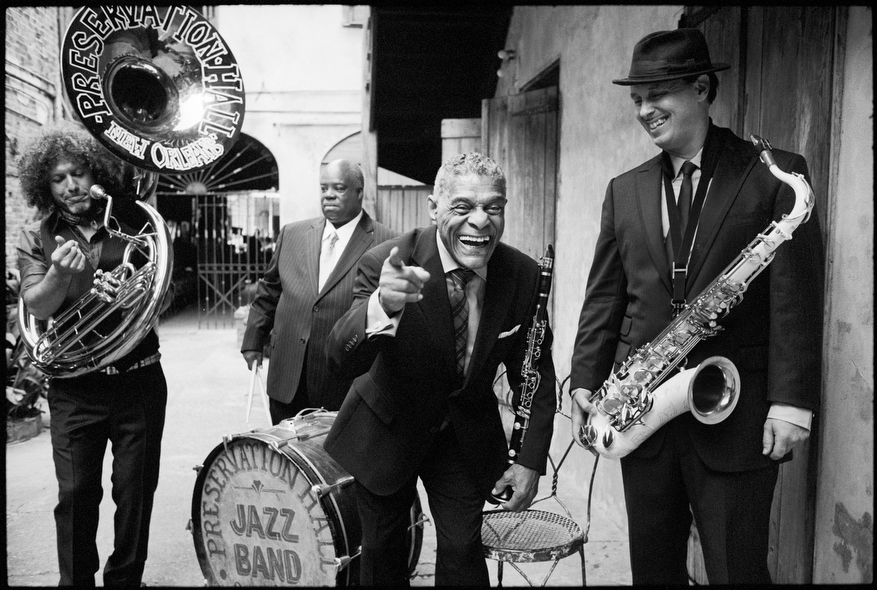
L-R: Clint Maedgen, Rickie Monie, Charlie Gabriel, Ben Jaffe. Photo by Golden Richard III.
It didn’t. Suddenly, that is. It’s taken almost 20 years to turn what
had been a smooth-sailing, well-oiled machine from its cruise across
the seas of nostalgia toward what would most certainly have been the
junkyard where old cultural movements go to die, and point it toward a
new future with a larger mission. Credit for that achievement goes to
Ben Jaffe,
who didn’t exactly inherit the family business, but he ended up running
it anyway. Ben’s father, Allan, formally accepted responsibility for
running the Hall (eventually purchasing it) with his bride, Sandra, in
June 1961. The couple spent the next 30 or so years creating and
maintaining what soon became a central and colorful American
institution—an old, dusty building in the French Quarter where old,
black men who still remembered the early years of jazz came to play
every night, while another band, similarly composed, toured the world,
becoming regulars at summer music series and festivals.
All was running smoothly until the unforeseen occurred: Allan Jaffe
died of a heart attack in 1987 at the unfortunately young age of 53. Ben
was just a junior in high school, and his mother shipped him off to
college to have a life of his own while she and her sister and some of
their friends ran the Hall. Ben gravitated toward music, playing his
father’s instrument, the bass, but majoring in modern jazz at Oberlin
Conservatory and booking his own “neoclassical” modern combo in local
cities on weekends. The summer he graduated, the Preservation Hall Jazz
Band’s bassist became too ill to travel, and Ben joined the band to play
tuba and bass, beginning with a six-week residency in Paris. When he
returned, he knew instinctively that running the Hall would be his
life’s work. No words were ever spoken, no contracts signed. It’s a
family business, so Ben still needs family approval. But that’s never
been much of a problem since most of what he’s done has happened
organically, one change at a time. Slowly and methodically, he changed
the make-up of the band and eventually the very definition of the Hall,
moving it from within the narrow confines of jazz history into the wide,
open world of American roots music.
“When I took over responsibility for managing Preservation Hall, I was only 22,” Ben
told
writer Alison Fensterstock recently. “I was petrified that we’d cease
to exist when the original band passed away.” In his first two years at
the helm, that’s exactly what happened. Willie Humphrey, the 93-year-old
lyrical clarinetist who’d been associated with the Hall since its
founding in 1961 passed away in the summer of 1994. His younger brother,
Percy, the trumpeter who’d been a solid and reliable bandleader since
the Hall’s founding,
passed away the following summer
at the age of 90. “For the first six or eight years,” Jaffe recalls,
“I’d have to spend half an hour after every show talking to fans about
the band and what was going to happen now that Percy and Willie were
gone. Some of these folks had been following the band for 20 or 30
years.
“Somewhere in the late 1990s, I realized what they really wanted was
to experience New Orleans’ unique musical traditions. Over the years,
Preservation Hall had come to represent those traditions in a very
specific way. When I was growing up, I experienced New Orleans music as a
living, breathing organism. The more I recognized Preservation Hall’s
role in keeping New Orleans’ music traditions alive, the more I realized
the way those traditions were being represented would have to change.
And the audience would have to change. When I joined the Preservation
Hall band, it was rare that you’d find anyone in our audience under 60
years old. It was a very mature audience.”
The changes began as Jaffe resurrected the Hall’s recording label. He
began importing new music and new musicians into the band, recruiting
most notably Clint Maedgen from the
New Orleans Bingo! Show
on vocals and saxophone. Around the same time, the two collaborated on a
version of the Kinks’ “Complicated Life.” Long-time fans found such
decisions heretical.
“I knew this wouldn’t be easy,” Jaffe says. “I knew that to find new
audiences, people weren’t going to come to me, I would have to go to
them. And I knew that change on this level might upset and confuse a lot
of people, but I decided if I was going to fail at this, at least I
would fail doing what I knew in my heart was right.”
Then came Hurricane Katrina, and Jaffe spent the next couple of years
deeply immersed in relief efforts, raising more than $3 million and
helping start a non-profit social service agency,
Sweet Home New Orleans, that continues to provide service to local musicians in need.
Just as relief efforts were dying down and recovery efforts beginning
to ramp up, a friend of Jaffe’s approached him with the idea of doing a
high-profile benefit album featuring the Preservation Hall Jazz Band
and a roster of guest artists. Jaffe took his friend up on her offer but
directed proceeds to The Preservation Hall Outreach Program—an effort
to introduce young people to the music and encourage their efforts in
perpetuating it.
Preservation (its unwieldy full title:
Preservation: An Album Benefiting Preservation Hall and Its Music Outreach Program)
received quite a bit of attention and led the way to a 50th-anniversary
celebration in 2011 that played out the full range of potential
cultural celebration inherent in an institution like Preservation Hall:
art and history exhibitions; dance and theater collaborations; music mash-ups and joint tours.
After recording nearly all the Preservation tracks in the Hall’s
front performance room, the space itself seems to have come alive. After
the BP oil spill, Jaffe, the band, Yasiin Bey (formerly Mos Def),
Trombone Shorty, Lenny Kravitz and the actor Tim Robbins gathered there
to
record a rap/trad jazz protest song
based on the Wardell Quezergue and Smokey Johnson classic, “It Ain’t My
Fault.” When Amy Winehouse music producer Mark Ronson set out to lay
down his track for the recent Grammy-sponsored documentary
Re:Generation, he, along with Bey, Erykah Badu, the Dap-Kings, Trombone Shorty, and Zigaboo Modeliste ended up
playing a party at the Hall.
During the past two Jazz Fests, the hottest tickets outside the Fair
Grounds were for shows at the Hall. Two years ago, Jim James and My
Morning Jacket brought the rock world’s attention to the Hall with what
was, by all accounts a mesmerizing show followed by a 3 a.m. parade
around the empty streets of the French Quarter, and last year Robert
Plant made an unscheduled appearance at the Saturday Night show
headlined by guitarist Buddy Miller, his music director.
As if to confirm its status as an essential American roots band, the Preservation Hall Jazz Band was
featured this past October on
Austin City Limits with guests Jim James and the Del McCoury Band.
Jaffe insists that music fans who check out the Economy Hall set the
day before won’t hear much difference in the music being played. The
real difference, he says, will be in the make-up of the two audiences.
And in that, he’s mostly right. The Preservation Hall Jazz Band
continues to play in the same tradition that prevailed in the years when
it was founded. For some people, that’s a tradition set in stone, never
to be varied, but traditions have to breathe to live, and all Jaffe has
done is set Preservation Hall free from a set of responses that are no
longer as effective as they once were. Repositioned as an American roots
institution still very much alive and well, New Orleans Preservation
Hall and its world-traveling jazz band—even at the ripe old age of
50—are back on the American music radar in a major way.
Preservation Hall Jazz Band plays Jazz Fest on Saturday, May 5 at
4:25 p.m. on the People’s Health Economy Hall Stage and on Sunday, May 6
at 5:35 p.m. on the Gentilly Stage.







.JPG)
.JPG)